AI implementation that starts with the work.

Move from scattered experiments to a defined workflow your team can understand, test, review, and improve—with clear ownership and responsible boundaries built in.

A facilitator maps a workflow on a wall while three colleagues take notes around a table.

Fit before tools

A practical fit for repeated work with a real owner.

We work with practices, schools, professional teams, associations, healthcare businesses, and founders who can name the work they want to improve—and the people who must stay responsible for it.

Good fit

You have a workflow worth understanding.

The strongest starting points are repeatable, reviewable, and tied to an operating need.

  • A team repeats the same research, writing, planning, or administrative task.
  • A named owner can define data, approval, review, and escalation boundaries.

Outside scope

The line stays clear.

NurseBuiltAI does not implement general-purpose AI as a substitute for clinical judgment, approved clinical systems, policy, supervision, or direct patient-care decisions.

  • No autonomous clinical decisions or patient-specific recommendations.
  • No identifiable, confidential, or regulated data in unapproved tools.

Ways to work together

Choose the level of support the work needs.

An engagement can clarify one decision, train a team, shape a contained pilot, or support the path from discovery through handoff. Scope is agreed after the first conversation.

The method

Discover. Design. Pilot. Equip.

Each stage makes four things explicit: the output, the human owner, the safeguard, and the next decision. That keeps implementation connected to the work long after a workshop ends.

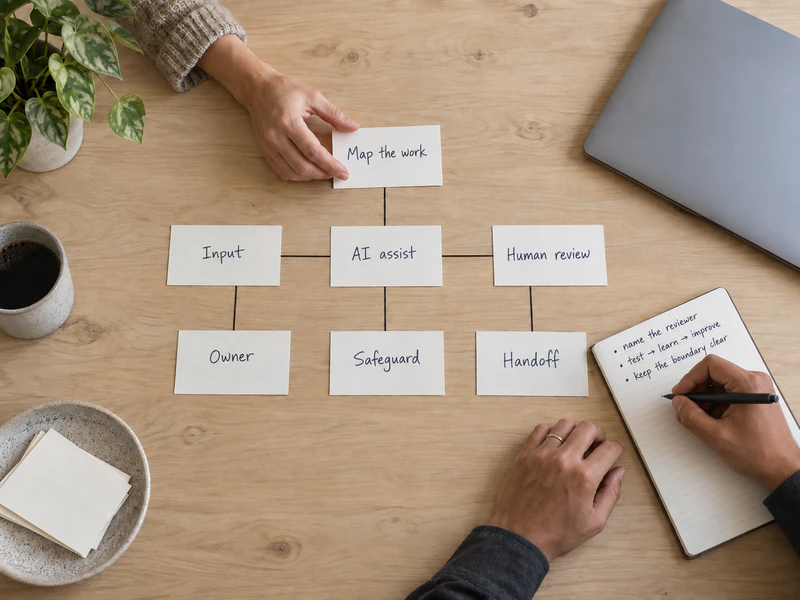
Hands arrange workflow cards labelled Map the work, Input, AI assist, Human review, Owner, Safeguard, and Handoff beside a notebook.

Tools enter the conversation only after the workflow, information boundaries, review responsibilities, and desired evidence are visible. Preview the Implementation Readiness Canvas used to frame those decisions.

  1. Stage 01

    Discover

    Output
    Current-state workflow map and a focused opportunity brief.
    Human owner
    The person accountable for how the work operates today.
    Safeguard
    Identify sensitive inputs, approved environments, constraints, and non-negotiable review points.
    Next decision
    Is this workflow suitable and valuable enough to design?
  2. Stage 02

    Design

    Output
    Future-state flow, prompt or tool specification, roles, and test criteria.
    Human owner
    A workflow lead who can approve the proposed operating pattern.
    Safeguard
    Define what the system may assist with, what it must not do, and when people intervene.
    Next decision
    Is the design bounded, reviewable, and ready for a small pilot?
  3. Stage 03

    Pilot

    Output
    A contained pilot, observation log, and evidence for a go, revise, or stop decision.
    Human owner
    A pilot lead plus named reviewers for every consequential output.
    Safeguard
    Use approved test inputs, documented review, escalation routes, and clear stop conditions.
    Next decision
    Should the workflow stop, change, repeat, or move toward wider use?
  4. Stage 04

    Equip

    Output
    Working documentation, training materials, handoff, and an improvement cadence.
    Human owner
    The operational owner who maintains access, guidance, review, and updates.
    Safeguard
    Keep version history, feedback channels, review checks, and a route to retire the workflow.
    Next decision
    What will be monitored, by whom, and when will the workflow be reviewed?

Responsible by design

Principles that shape every workflow.

Responsible implementation is not a disclaimer added after the build. It changes the inputs, permissions, review steps, documentation, and ownership from the start.

01

Protect data

Use only what the task requires, in tools approved for the organization’s policies and permissions.

02

Verify outputs

Define how claims, sources, calculations, and generated material will be checked before use.

03

Name the reviewer

Assign a person to approve consequential work and own the final decision.

04

Keep an exit

Document escalation, pause, revision, and retirement conditions before wider adoption.

Where to look

Use-case categories for discovery.

These categories are conversation starters. A use case is not suitable simply because AI can touch it; fit depends on the actual work, information, risk, owner, and review path.

Category 01

Internal knowledge

Organizing approved policies, procedures, notes, and source material so staff can locate and summarize information for review.

Category 02

Education operations

Drafting lesson structures, practice activities, facilitator notes, and internal training materials from verified sources.

Category 03

Business communications

Preparing first drafts, adapting approved messages, and creating reviewable communication workflows for teams.

Category 04

Meetings and projects

Structuring agendas, action logs, project briefs, status updates, and handoffs without exposing confidential material.

Category 05

Content systems

Turning an approved idea into a traceable research, drafting, review, reuse, and publishing process.

Category 06

Workforce and member support

Developing non-clinical career resources, onboarding materials, question libraries, and program communications.

Clinical boundary: these examples do not include diagnosis, treatment selection, triage, medication decisions, patient-specific recommendations, or replacement of approved clinical systems and professional judgment. Read the full Responsible AI framework.


Primary frameworks

The method is grounded in risk, privacy, and accountable ownership.

These U.S. primary sources inform the questions NurseBuiltAI asks about context, risk, data, review, measurement, and ongoing ownership. They do not certify this method or establish legal compliance. Applicability depends on the organization, information, technology, and jurisdiction involved.

NIST / AI risk

AI Risk Management Framework

NIST’s voluntary framework organizes AI risk work around Govern, Map, Measure, and Manage across the system lifecycle.

Read the official NIST AI RMF
NIST / Generative AI

Generative AI Profile

NIST AI 600-1 describes risks that generative AI can introduce or intensify and suggests cross-sector risk-management actions.

Read NIST AI 600-1
NIST / Privacy

Privacy Framework

NIST’s voluntary Privacy Framework supports enterprise privacy-risk identification and management without presenting one universal control set.

Read the NIST Privacy Framework
HHS OCR / ePHI

HIPAA Security Rule risk analysis

For regulated entities handling ePHI, HHS OCR describes risk analysis as foundational and ongoing. Whether HIPAA applies must be determined for the actual entity and workflow.

Read HHS OCR guidance

Sources checked . The current NIST AI RMF page notes that version 1.0 is being revised; source status is reviewed before substantive updates.

Who is implementation support for?

It is designed for practices, schools, professional teams, associations, healthcare businesses, and founders working on education, operations, workforce, communication, or business workflows. Fit depends on the specific process and its responsible-use boundaries.

Do we need to choose an AI tool first?

No. Discovery starts with the work, users, inputs, decisions, and constraints. Tool requirements can then be evaluated against that picture and your organization’s approved environment.

Can the work involve patient or confidential information?

NurseBuiltAI does not advise placing identifiable, confidential, or regulated information into general-purpose tools. Any workflow involving sensitive data requires the organization’s own policy, privacy, security, legal, and governance review, plus an appropriately approved system.

Start with the repeated work

Bring one workflow you want to understand better.

Share what the team repeats, who is involved, where the friction sits, and what a responsible first test might need to prove. You do not need a finished tool list or AI strategy.